Tuesday, May 11, 2010

Old Ladies, Old Trees & Soba

I have made quite a few old lady friends since moving to Japan. Call me an ageist, but I have spent most of my life hanging out with my peers. It seems this was a huge mistake. Great things happen when you're chillin' with the 50-70 year old crowd. The common denominator seems to be this: amazing food, beautiful off-the-beaten path locations and thoughtful little gifts. Plus, none of them work so they are free to drive me around on my Mondays off. *fist pump*

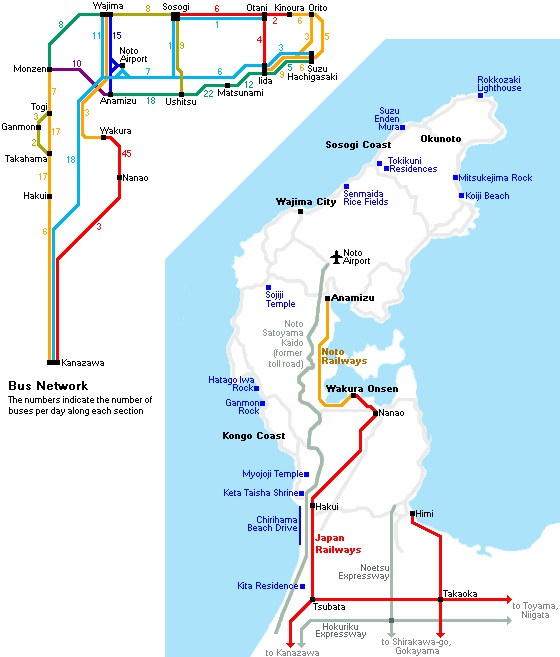
When one of the women in the cooking class I taught mentioned that her and her husband own a soba restaurant in Hakusan City, a beautiful mountain town about an hour from Kanazawa, I made a squawk about wanting to eat there. Old ladies respond well to squawks. An email was sent. A plan was conceived. A car would pick me up in front of the meat shop on Monday at noon.


So that's how the post-menopausal posse and I found ourselves in a four-door sedan, winding through the most vivid green valley; past rice paddies, bamboo forests and unruly bushes bright with blossoms. The Spring hillsides represented every imaginable shade of green. It was like porn for Bob Ross. The landscape sent me into a tree hugging trance, and I did something I hardly ever do: I shut the fuck up. While the ladies clucked and laughed and grunted, like only Japanese people do, I gazed sleepily out the window.

Soon enough we arrived at the restaurant, a big old house that has been in the owners' family for generations.

Everything brought to the table was either local, handmade or foraged. Locally grown buckwheat was weaved into half the dishes. We slurped cold, toothsome soba noodles, handmade by the husband that morning, topped with little mushrooms and a snowy mound of grated daikon. We lifted tangles of the brown flecked noodles from the broth and dunked them into gooey mountain potato flavored with wasabi. There was incredibly flavorful local tofu, served cold and topped with scallions and just the slightest drip of soy sauce, "So you can really taste the tofu flavor." Spicy foraged mountain greens were transformed into tempura, so light and barely battered that the leaves shattered between our teeth.

But it was dessert that had me the most intrigued. The wife was responsible for the lovely soba and soy sauce flavored puddings, incredibly creamy little flan-like domes topped with sweet, homemade, soba syrup and toasted buckwheat berries. There were rectangles of buckwheat infused gelatin, the size of business cards, and tiny nubs of homemade caramel flavored with buckwheat and soy sauce.We sipped buckwheat tea and even slurped down the water used to boil the soba noodles, poured out of a little tea pot and seasoned with salt.

It was a meal that represents everything I love about Japanese food. Not only was it fresh, local and handmade, but it was prepared according to tradition and with purpose. It fills your belly just enough, so that you are neither hungry nor food coma full. It's composed of several small dishes, offering a variety of textures and temperatures. Chopsticks force you to eat slowly, to eat one mushroom at a time, to enjoy the flavors and contemplate your next bite.

Our bellies full of buckwheat, we took off down the road to find an old cedar tree, planted by monks 1,200 years ago. The restaurant owners told us the tree will "give you power." The cedar's massive trunk was covered in a soft carpet of moss, and the bark was cracked into a thousand puzzle pieces. It's fat, burly limbs stretched out in every direction. The ladies stopped their chatter, pressed their palms to the moss and closed their eyes. After circling the tree several times, running my hands along the soft green fuzz and squishy bark, I found myself doing the same. Silly as it sounds, I felt the power. I made a wish on the tree, and rubbed it's 1,200 year old skin like a genie's lamp. Five women, ages 30 to 74, holding up a giant cedar tree with our 10 outstretched palms.

Sunday, April 25, 2010

Remember That One Time When I Taught a Cooking Class?

As William Bell, and then Otis Redding, The Byrds, Taj Mahal, Peter Tosh, Brian Eno and The Mother Hips, once sang: You Don't Miss Your Water Till Your Well Runs Dry.

Those boys were waxing metaphorical about a lady. I'm just talking about my oven.

I don't even know how often I used my oven at home, but now that I don't have one, it seems every amazing-sounding recipe I stumble upon, every comforting dish that I crave, requires one. I have never been much of a dessert baker, but the one thing I consistently preheated for was my all-time favorite oatmeal chocolate chip pecan cookies. I would often stir up a big batch, roll the dough into logs, freeze them, and slice and bake fresh cookies when the mood struck. You can keep a man with this recipe. A hot one. Who plays Scrabble.

So, when I was invited to teach a cooking class to a group of Japanese people, one of the first things I asked was "Will there be an oven?"

The cookies were an obvious choice, but deciding the rest of the menu was trickier. Suddenly, I lost all of my cooking confidence. First it was my fault: What if my recipes suck and they chase me out of Kanazawa waving dry, flavorless chicken legs? Then it was their fault: What if my delicious recipes don't appeal to their mild, Japanese palates and they chase me out of Kanazawa waving torch shaped hunks of wonderfully stinky blue cheese?

I wanted to present dishes I've made many times, that have an Americana quality, that are easy to make and don't require too many exotic ingredients. Finally, I settled on a menu: seared pork chops stuffed with garlicky spinach and blue cheese & roasted garlic, yogurt and scallion mashed potatoes. We'd have French bread and butter to nibble and the cookies with tea for dessert.

The cooking class was held in a community center in Nagamachi, Kanazawa's old, preserved samurai district, and I was completely blown away by the massive kitchen. It was equipped with half a dozen cooking stations, each boasting a gas range, digital oven, a sink and plenty of counter space. My current home kitchen is the size of a coffin and moonlights as a hallway, a place to store my shoes, a laundry room, a body waxing station (what?) and contains approximately zero counters.
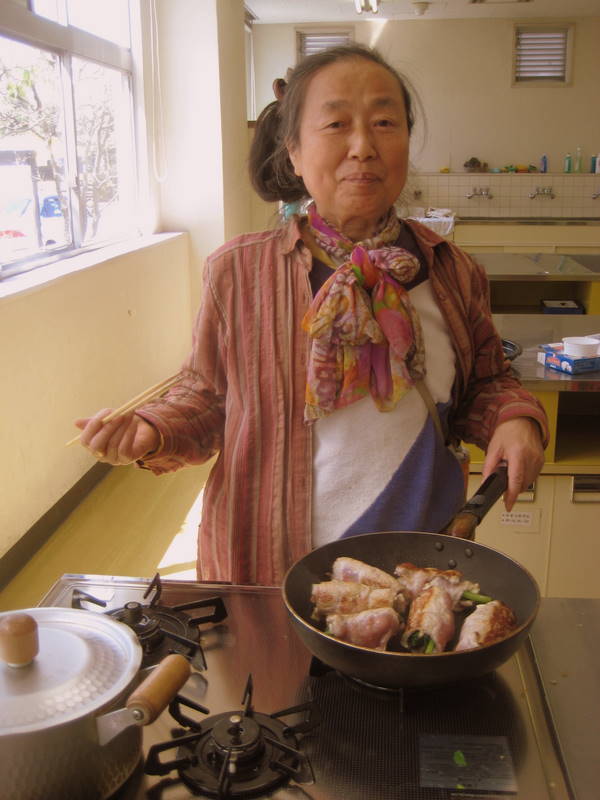
As we got cooking, I realized I was in a bit of a delicate situation. I had to instruct a group of mostly older, experienced, home cooks who, for the most part, don't speak my language. When I caught the sole gentleman in the group violently stabbing the already mashed potatoes with a wooden spoon, I gently told him that they were done. He didn't understand, and with a sweet smile on his face, continued to maniacally assault the mash. I tried again. And again. Nothing could stop him from his hateful stirring. Jesus! Did his wife leave him for a potato? Was he having a french fry flashback? Pound pound pound! Finally, I did what many Japanese have done to me, a gesture I absolutely abhor: I crossed my index fingers into an X and held them in front of my face. He immediately released the spoon. "Finished?" he asked. "Finished." I answered.

Our crew worked together to crank out the dishes, and before long we were sitting on low stools, ready to eat, watching the blue cheese happily ooze from it's porky caves. I felt nervous again. Is the pork gonna be dry? Why didn't I make a vegetable side dish? Am I only contributing to the stereotype that Americans only like meat and potatoes? But, soon enough, I heard the familiar chorus of "oishi!" and relaxed into my lunch.

The abused potatoes survived their attacker, most definitely lump free and tangy with yogurt, and the cookies were just as they should be: crisp on the outside and soft and gooey inside, with the occasional crunch of a nut.

Perhaps my current state of singledom can be single-handedly blamed on my lack of chocolate chip oatmeal pecan cookie production. Yes, that must be it. Seeking: hot, Scrabble loving, man with oven. I'll bring the cookie dough.

Monday, April 19, 2010

Wriggle squirm chew! Eating Live Fish in Noto

"I am so excited, I am going to eat live fish in Noto on Sunday!"
"Oh, you mean, like, sashimi?"
"No! Not raw fish, LIVE fish. Fish that are STILL ALIVE!"

I had this conversation a few times over the past week as I excitedly prepared to chomp over two dozen live little fishies at Chanko Nabe Ichihin Ryouri RIKI, a restaurant in Anamizu. I really had no idea what to expect, but I have been extremely curious for several years, ever since an old KIRO coworker showed me a video of him in a Tokyo restaurant pinching a flipping fish between a pair of chopsticks.

What I did not expect was a modest little family restaurant with a small aquarium on it's counter. It was absolutely bustling with tiny, transparent fish called isaza, plucked from the Sea of Japan just down the road. I also didn't expect the fish to look as though they were smiling. We put in an order and padded it with some snapper sashimi, local fish and vegetable tempura-don, and grilled oysters and leeks with butter.

As you will see in the video, I came into the experience a little bit cocky. I had no idea that I would be initially terrified of the little fish, squirming, wriggling and splashing around in the bowl of water before me. They were either saying "Please please eat me! Pick me! Pick me!" or "Holy shit! We have to escape NOW!" Despite what the folks at PETA might say, fish can't talk or make facial expressions, so it was impossible to tell what they were going on about but clearly they were freaking the fuck out about something. So was I. They were smiling, they were slippery and I was about to kill them with my teeth.

Turns out it only takes about two little fish to change me from a wimp into a savage. Soon enough I was holding one in my mouth before chewing, feeling it flip and frolic about like a bouncy ball let loose in a racquetball court. Sometimes I swallowed them whole, disappointed when I didn't feel them wriggling down my throat and swimming around in my stomach. By the end, full from the rest of our meal and still marveling at the amazing oysters, I just wanted to get rid of the last four little suckers. One by one I chopsticked them into my soy sauce, added a little water, and shot the whole thing back. I let them swim around inside my soy mouth aquarium before chewing them up and swallowing them down.


Here's a quick little shorty:


One more if you just haven't had enough. This one's pretty entertaining:

Sunday, April 18, 2010

Teacher's Pet

In the first grade I was a teacher's pet. I absolutely adored Mrs Reding, my red headed & freckled teacher who had a particular penchant for Garfield paraphernalia. At recess I had to fight off the other little goody-two-shoes girls in order to attain the ultimate Teacher's Pet Honor: holding one of Mrs Reding's hands as she walked around the playground busting little boys for doing naughty things. My family moved across the city after 1st grade, so I had to change schools, but I would visit Mrs Reding about once a year and bring her a pack of Garfield pencils. She even attended my Bat Mitzvah. She was the one, and I would never love another teacher quite as much. My career as a teacher's pet was short and sweet; it ended after a single year at Fairlands Elementary School.

But, 25 years later, it appears I am back to my old eager-to-please school girl ways. I realized this the other morning at my monthly cooking class as I painstakingly sliced carrots into uniform matchsticks.

"Very nice!" said Chieko, one of my cooking teachers, admiring the mound of orange shreds. I beamed a little too much. I longed to buy her a Garfield pencil.

From my very first class, months ago, I had an agenda: to befriend the middle aged cooking teachers, get them to teach me private lessons, and learn a bit about Japanese culture through their stories and recipes. It seems my stored-up teacher's pet powers are still strong since all of these things have come true. Chi-chan, a tell-it-like-it-is tough cookie of a grandmother (right), calls herself my "Japanese mom," has taken me on a couple of adventures and buys me gifts when she goes on weekend trips. Emi-chan, the always sweet and smiling grandma, gives me little photo collages of our experiences together and treats from her small garden. A true pet, I have reciprocated with chocolates, ice cream and crunchy snacks. 

On Thursday, Yoko and I arrived at the monthly group cooking class expecting the usual scene: a kitchen crowded with clucking hens chopping up vegetables and stirring bubbling pots. But it was only Emi-chan and Chi-chan. Strangely, no one else was coming this week. It was a teacher's pet dream! There would be no fighting for the choice cooking tasks and I could easily watch each dish come together from start to finish. We tied on our aprons and got to work preparing two home-style main dishes for a group of hungry lunchers: chirashi-zushi and kara age (pronounced: Car-uh ah-gay), Japanese fried chicken.


In Seattle, chirashi-zushi was a bowl of warm sushi rice covered with slices of raw fish and, if I was lucky, a heaping spoonful of shiny orange salmon eggs. But apparently there isn't always fish involved. Our version was vegetarian and involved carrot, shitake and gobo (burdock root) stirred into piping hot sushi rice. Each bowl was then topped with slices of rincon (lotus root, pictured) and ribbons of thin, crepe-like omelet. We garnished with shreds of shiso leaf, chopped snow peas and pickled ginger. Each bite was like a little rainbow: the red ginger, orange carrot, yellow egg and green shiso. It was simple, beautiful and took far longer to prepare than I expected since each vegetable is boiled separately in water spiked with different flavors.
For me, fried chicken falls into the same category as sour cream and onion dip and Lil Smokies: unsophisticated, unhealthy, delicious foods that I never make at home but will gleefully inhale at a party. Japanese fried chicken is exceptionally yummy; small chunks of thigh meat marinated in classic Japanese flavors and fried until the outside is golden and the inside ridiculously juicy. It is often served with undressed lettuce leaves and, in this case, wedges of tomato to counteract the artery clogging oil.

Maybe it was the magic of fried chicken that cast a spell on my teachers and caused a true miracle to happen at the end of this cooking session. Chi-chan hugged me. She hugged me. First! Without prompting! Let me explain. Japanese people are not particularly affectionate and they absolutely do not hug or kiss each other in public. I started hugging the ladies months ago. At first they responded by standing stiffly, arms at their sides, with frozen smiles on their faces as I squeezed their tense bodies. As the months went by they gradually loosened up and reciprocated with a little back pat or maybe a sideways squeeze, but I was always always the initiator. Until Thursday. Chi-chan hugged me goodbye. It was just as good as holding her hand during recess.

Sunday, April 11, 2010

Weekend in Nara: A Foreign Food Frenzy

I feel a bit sheepish writing yet another post about foreign foods. I'm probably supposed to be writing a detailed piece on the origin of the soy bean and recount how I spent several days carving a slab of tofu into the shape of a samurai before immersing it in soy sauce and serving it to a geisha. But I eat plenty of delicious Japanese food in Kanazawa, so when I blast off to a bigger city for the weekend, I'm all about fulfilling my foreign food cravings.

One thing I really miss about home is cafe culture. In Seattle I spent a fair amount of time hunkered down in independently owned coffee shops, sipping lattes and playing Scrabble, while the ironically tattooed baristas noisily foamed milk and contemplated their facial hair. As the rain continues to fall in Kanazawa, I long for a cozy cafe to read my book in at 9 o'clock at night. Turns out Nara is just the place to do this. The city has a number of adorable little cafes; all bright, colorful and modern in that shabby chic meets Ikea catalog kind of way. It is all a bit ironic (maybe even more so than a hipster tattoo) since Nara is famous for being one of Japan's oldest and most historical cities.

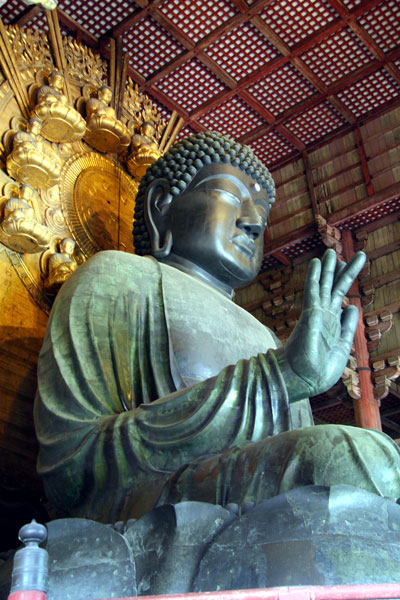
My friend Kate and I decided to indulge in both the old and the new Nara: we photographed ancient temples and gawked at Japan's largest bronze Buddha statue & then frolicked off to munch on organic doughnuts and Israeli falafel.

Third Place Cafe

I have never been able to muster up much excitement for a muffin. "Muffin shmuffin!" I've always thought. Actually, I have never thought that. But I've just now discovered that it's really fun to say out loud. Anyway, when muffins come in flavors like black sesame, matcha (green tea) with black beans & walnut my interest has been piqued. The owner of Third Place Cafe says her muffins are American inspired, which is to say huge, and she bakes them fresh all day long. My black sesame was still steaming when she popped it into a paper bag for me to take home. I longed to lounge around in the European feeling, sunlit, cafe but alas sightseeing called.


Floresta

The people behind Floresta are pretty smart. They positioned the doughnut case right in front of the shop's wide open entryway, so that you can't possibly walk by without being magnetically pulled in by the enchanting little o's. The doughnuts are made with organic, natural and free range ingredients and they actually taste healthy. Yes, healthy doughnuts, an oxymoron for certain. That is, unless you tuck one away for the next morning. Whereas my "natural" doughnut was tasty eaten on the spot, my Early Gray flavored one released its hidden greasiness overnight and left a nasty, oily film in my mouth. Kate and my favorite thing about Floresta? A message written on the company's brochure: "The owners wish to provide safe and delicious doughnuts for everyone." Amen. Dangerous doughnuts are a serious problem and it takes a lot of courage to be proactive, really step up to the plate, and actually do something about it.

Falafel Garden

Traveling with a vegetarian isn't for the weak. Especially in Japan where nearly every dish is spiked with dashi, a fish based broth. Yes, vegetarians are nice people (well, sometimes), and perhaps they have higher morals than I do (I eat animals, but I recycle, OK?!), but getting in between me and my dinner is serious business. So I was seriously excited to stumble across Falafel Garden while doing some pre-trip restaurant research. Kate and I talked about Falafel Garden for the week leading up to our trip, we talked about Falafel Garden on the train ride to Nara and we talked about Falafel Garden while sitting in Falafel Garden. The quality of this highly anticipated meal could make or break the trip. The familiar panic set in while I scrolled the large menu. I only had one shot to get this right. Would only a fool order the grilled eggplant and baba ganoush pita sandwich? Should I get a falafel since the place is called Falafel Garden? I finally decided on the chicken shwarma sandwich and threw in a side of hummus for good luck. It worked. The chicken was super juicy and flavorful, the pita was packed with fresh veggies and each bite was smeared with the creamy hummus. Turns out I didn't only have one shot to get it right. FG does take-out, so I was able to enjoy an incredibly drippy, overstuffed falafel sandwich on the train ride home.

Café Wakakusa 

Absolutely starving, and therefore too hunkry (hungry + cranky) to track down another restaurant from this super helpful guide, Kate and I took a chance on a no-frills okinomiyaki joint whose name may forever remain unknown. I had been unimpressed and uninterested in the popular savory pancake for several months, but this little greasy spoon unexpectedly restored my faith. Full bellied and rehydrated, we were able to continue our cafe quest and ended the night at Cafe Wakakusa. Inside, everything from the walls to the floor to the cafe owner's pants and shirt were different shades of vivid green. I decided to stick with the trend and ordered a matcha latte. Kate was entranced by her mug of hot chocolate, topped with zigzags of chocolate sauce. A fashionable couple (is there any other kind in Japan?) came in, slurped up big bowls of yummy looking pasta, and left. We listened to soft Japanese lounge pop (a band which I now love and still can't find mention of anywhere online) and I begged the owner to open a second branch in Kanazawa.

XXX

This now (mostly) concludes the food portion of this post. Here are a collection of photos from our weekend trip in Nara, a quaint, easy to navigate city outside Kyoto that is now one of my favorite places in Japan. We also took a side trip to Akame Shiju-hattaki Falls, a beautiful forest about an hour outside of Nara for a day of hiking and waterfalls.

Nara's most famous temple, Todai-ji, was built in 745 and houses Japan's largest bronze statue, a 15 meter tall Buddha perched on a lotus flower. In person, it is truly a beautiful and mesmerizing piece that is hard to walk away from.

The cherry blossoms were already blooming.

Nara is famous for a huge, sprawling park that is home to thousands of free roaming deer and just as many moss covered stone lanterns.
Class photo day! 

 One of Akame Shiju-hattaki's 48 waterfalls.


Every city, town and village in Japan seems to have it's own culinary specialty, even if it's just a very slight variation on a popular national dish. This old gal is serving up one of the best sweets Kate and I have tasted in Japan. It's a delicious twist on taiyaki, typically a little fish-shaped cake made of pancake batter and filled with adzuki bean paste. In this case the batter was sweet potato puree. It was soft, creamy, sweet and earthy. Perfect with a cup of tea, or in my perfect world, a glass of milk.

Sunday, March 28, 2010

The Sweet Potato Truck!

There are times when I actually forget that I'm living in another country. My workplace is sandwiched between two bustling Starbucks and situated across the street from a 24 hour McDonald's currently advertising four special "Big American Burgers."

But a few months ago, my BFIJ and I were making our way to a conveyor belt sushi restaurant when I heard an extremely loud, obnoxious, sing songy man's voice that seemed to be coming out of the sky. "Is it God?" I asked Yoko. "No," she assured me, "Better. It's the sweet potato man."

Sure enough, a little truck was inching it's way down the road, blaring a looped message in Japanese. Even bundled up in my gloves, scarf, coat and hat it was brain-freeze-cold outside and the idea of holding a red hot sweet potato in my hands sounded very appealing. "We gotta get one!" I called to Yoko and ran into the street to flag down the truck.

I'm not sure how prosperous this old fashioned venture is, but I love the idea of a vendor selling a single delicious product. The old man hopped out of his truck, selected a rock roasted potato from his stash and plunked it into a paper bag. That's it. No butter, no salt, certainly no blasphemous mini marshmallows. But I'll be damned if these completely naked Japanese tubers aren't the creamiest, most flavorful, absolutely luscious potatoes I've ever tasted. Recently, I bought another, for less than half the price of the truck tater, at my local grocery and it was even better. Unable to control my sweet potato lust, I hightailed it to the register, and spent my walk home dreamily munching on my purple skinned breakfast.

Here's a video of our sweet potato truck encounter, featuring Yoko translating the truck's message:

Saturday, March 20, 2010

When in Japan, Learn to Make Tortillas

My friends, the time has come. The time has come to stop living a life without tortillas. I don’t even know how I made it this far. You see, back at home, the humble tortilla was a part of my daily life. Nearly every night I dragged one across the flame of my gas range until it warmed and softened, blistered and charred. I’d tear off strips and christen each with a few drips of Tapatio or Sriracha. Sometimes I drizzled the whole thing with truffle oil and a sprinkle of garlic powder. It's a reliable comfort food on it's own, and even better when wrapped around any number of tasty bits and pieces. I know I said all those nice things about rice, but the truth is you can't wrap that shit around anything!

I was golden for about three weeks after Cathy personally delivered a jumbo pack of flour tortillas, along with two cans of beans (refried and black), to my apartment door in Kanazawa. I rationed as best I could, while still dutifully sharing the bounty with my equally needy BFIJ two doors down. We feasted on pork fajitas, chicken shitake burritos and spinach and cheese quesadillas. We sliced avocados, sautéed onions and peppers and topped every chile and cumin scented creation with a dollop of plain yogurt. And then they were gone.

Then one day I realized: I can make tortillas! The ingredient list is short and basic and they don’t require an oven. Truly authentic tortillas call for lard, but I found plenty of recipes online that substitute easy-to-find vegetable oil.

Despite the lack of lard, I set out to make the tortillas as authentically Mexican as possible. I balanced a cutting board over the kitchen sink to create a countertop, rolled out the dough with a tall-can of Kirin and cooked them in a nonstick frying pan. With every roll of the can, Mexican grandmothers everywhere felt a sharp, stabbing pain in their hearts. They clutched their chests as the dough met the Teflon. Their daughters frowned, diagnosed them with heart burn and sent them off to bed with a handful of Tums. Lo siento, abuelitas.

It took a bit of fiddling with the heat and the thickness of the dough, but by the end I had a short stack of chewy tortillas, bubbled up in places and properly spotted with char marks. Perhaps they weren’t the best tortillas in the world, but they certainly seemed to be the next morning when I wrapped one around a heap of scrambled eggs and avocado. Not bad for a ghetto rigged operation conducted by a Jewish girl in Japan at midnight on a Thursday night.

Tuesday, March 16, 2010

Foodtopia : Kanazawa

"You know this is probably just gonna be fair food, right?" Yoko's glass must have been half empty as we slosh slosh sloshed through Central Park's lawn-cum-swamp, our wellies ankle deep in muddy slush and melted snow.


"Really?" I was disappointed. Really disappointed. I'd been looking forward to Foodtopia, Kanazawa's annual winter food festival, for weeks. Especially since we'd absentmindedly mixed up the dates and arrived at an empty park, bouncing like bunnies and starving, the Friday before.


But then I smelled it. The unmistakable scent of barbecue. Fresh local oysters, pried from the cold waters of the Noto Peninsula, steamed and whistled on long grills, sending smoke signals of love up into the sky for all to see. Fat scallops, giant shell-on shrimp, and butterflied squid were pierced with skewers and painted with a sweet soy sauce. If this was fair food, then I was a hungry carny. I channeled Templeton the rat from Charlotte's Web: "A fair is a veritable smorgasbord orgasbord orgasbord..."


The park was a sea of tents, each one selling some sort of eye catching, delicious looking treat. This being a festival, there were many foods on sticks. But instead of corn dogs and fried Twinkies, we were salivating over tender dumplings, filled with everything from pork to garlic and greens, portable strips of okinomiyaki and skewers of mochi balls.


"Today is the best day of my life," I said to Yoko as we passed a tent selling freshly fried tofu doughnut holes, as light and fluffy as a Danielle Steel novel. 


We decided to take a lap before committing. We were not about to make a rookie mistake. Only an amateur would fill her belly at the start of a food festival, only to miss out on what awaits at the very last tent. But surely we needed energy for this trek so we scooped up a plate of barbecued oysters and entered the maze of tents.
Our second commitment of the day was to a warm bowl of rice absolutely covered with negitoro (chopped fatty tuna belly and green onion) and the big ol' orange salmon eggs that go pop between your teeth. It was shockingly cheap and I ate my half slowly, savoring each little blast of seawater, the creamy tuna and chewy rice.
There was absolutely no way we could turn down the crab shells filled with hunks of crab, gooey crab guts and sweet claw meat. I may not be able to see the Sea of Japan from Kanazawa, but Foodtopia is proof that it's seafood stacked waters are only a 20 minute train ride away.


After sampling sesame coated chicken wings, chunks of jiggly mochi rolled in matcha powder, the aforementioned scallops and several dumplings it was time for something hot and steaming. We did what the Japanese do best, wait in line for something delicious, and were rewarded with the best bowl of ramen I've tasted in Japan. Rich and meaty, but not too oily, perfectly al dente noodles and excellent accessories; it was my first taste of Kyushu ramen delivered by a shop that traveled hundreds of miles to make me happy. 


"What's that singing? Is that live A Capella?" Of course it was. What better way to work off a belly full of food than to jog over to a big stage where four Japanese 20 year olds were belting out American oldies while two Japanese guys beat boxed in the background? Love Potion No. 9 (or as they sang it: Ruv Potion) will never be the same again. Yoko and I sang along, danced and clapped, while the audience sat still and silent. The girls smiled big, giggled and waved at us from the stage.

The older I get, the more I crave sweets, so we capped off our morning at Foodtopia with a visit to the taiyaki stand. The popular little fish-shaped pastries are traditionally filled with adzuki bean paste, but here we could also choose from several custards with flavors like vanilla, chocolate and espresso.


 "Today is the best day of my life," I told Yoko for the seventh time that day.


Then we did what nobody wants to do after they've skulked around a food festival for hours, stuffing themselves silly like Templeton the rat: we went to work. Sometimes the best days of your life are only two hours long.


Sunday, March 7, 2010

Instant Ramen Museum: Osaka Weekend Part II


I have recently taken on the role of Crazy Food Museum Girl. If I had children they would probably be sitting in the back of a station wagon right now, sighing, rolling their eyes and whining. "Mommmmm! Do we have to go to the canned corn factory? We just toured the Ritz Crackers museum for Dad's birthday!" So I'm thinking it's a pretty good thing I don't have children. They would have totally ruined my plan to visit The Instant Ramen Museum in Osaka and that would have totally sucked because this museum is what dreams are made of. 

Top 5 Reasons Why The Momofuku Ando Instant Ramen Museum Made My Heart Go Pitter Patter:

1.) They have English audio guides! As I mentioned before, Yokohama's Ramen Museum was a bit of a let down because everything was in Japanese. But here I was able to soak up all kinds of useful instant ramen knowledge. Like, did you know that Momofuku Ando, creator of Cup Noodles, also invented the Styrofoam cup? Fascinating! These facts don't just grow on trees, people.

2.)YOU GET TO MAKE YOUR OWN CUP OF NOODLE! That's right: capital letters. Capital letters mean I'm serious about how awesome this is. This is awesome. Drop three 100 yen coins into a vending machine and an empty Styrofoam cup will drop out. You are then invited to sit down, in my case with an entire elementary school class on a field trip, with a basket of markers and decorate your cup. Then, take it up to the assembly line to receive your noodles. Here you get to choose what flavor broth you want (I chose Seafood) and four ingredients. I selected little bits of freeze dried asparagus, imitation crab, scallions and fish cakes shaped like little pink hearts and stamped with "Love." Next, watch as your cup is properly sealed and wrapped in cellophane. Brilliant! The Cup Noodle Factory wenches should also be mentioned: not only are they amazingly chipper and patient, they know that everyone wants to take about a billion photos of their personalized Cup Noodles. Without being asked, they automatically pose and hold up the cup for photos after every step.

3.) The museum is bright, clean, colorful and The Instant Ramen Tunnel highlights Cup Noodle and instant ramen packages sold around the world, from past to present.

4.) If you come on a day that was not the day that I came, you have the opportunity to make fresh ramen noodles. The museum offers hands-on courses, every day except Monday and Tuesday, so you can learn to stretch, knead, roll, cut and taste homemade ramen noodles. This only costs about $5.
 
5.) Oh, and speaking of money: the museum is free. Hurrah!

Perhaps I've slurped up all the noodle museums Japan has to offer. Fortunately the country is full of food obsessed tourists, which means there are many culinary theme parks.  Get in the car, kids! We're going to Gyoza Stadium!