Showing posts with label cooking class. Show all posts

Sunday, April 25, 2010

Remember That One Time When I Taught a Cooking Class?

As William Bell, and then Otis Redding, The Byrds, Taj Mahal, Peter Tosh, Brian Eno and The Mother Hips, once sang: You Don't Miss Your Water Till Your Well Runs Dry.

Those boys were waxing metaphorical about a lady. I'm just talking about my oven.

I don't even know how often I used my oven at home, but now that I don't have one, it seems every amazing-sounding recipe I stumble upon, every comforting dish that I crave, requires one. I have never been much of a dessert baker, but the one thing I consistently preheated for was my all-time favorite oatmeal chocolate chip pecan cookies. I would often stir up a big batch, roll the dough into logs, freeze them, and slice and bake fresh cookies when the mood struck. You can keep a man with this recipe. A hot one. Who plays Scrabble.

So, when I was invited to teach a cooking class to a group of Japanese people, one of the first things I asked was "Will there be an oven?"

The cookies were an obvious choice, but deciding the rest of the menu was trickier. Suddenly, I lost all of my cooking confidence. First it was my fault: What if my recipes suck and they chase me out of Kanazawa waving dry, flavorless chicken legs? Then it was their fault: What if my delicious recipes don't appeal to their mild, Japanese palates and they chase me out of Kanazawa waving torch shaped hunks of wonderfully stinky blue cheese?

I wanted to present dishes I've made many times, that have an Americana quality, that are easy to make and don't require too many exotic ingredients. Finally, I settled on a menu: seared pork chops stuffed with garlicky spinach and blue cheese & roasted garlic, yogurt and scallion mashed potatoes. We'd have French bread and butter to nibble and the cookies with tea for dessert.
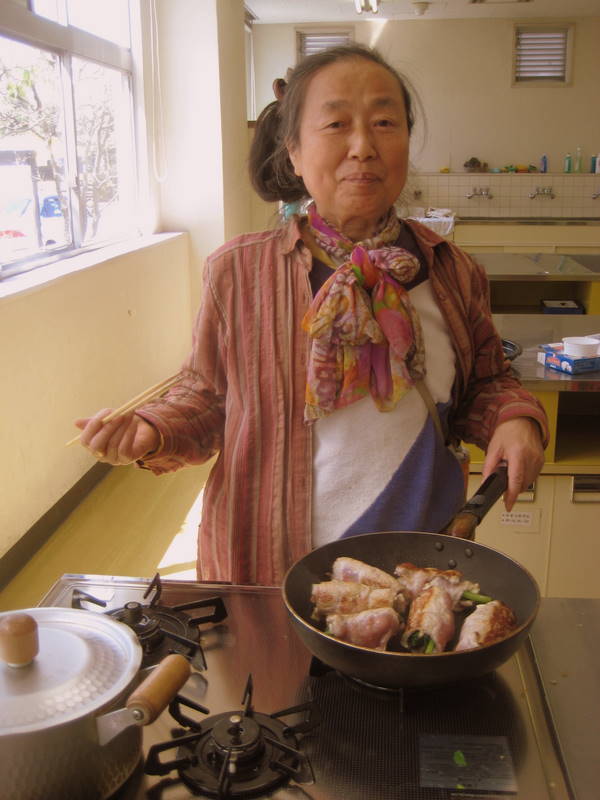
The cooking class was held in a community center in Nagamachi, Kanazawa's old, preserved samurai district, and I was completely blown away by the massive kitchen. It was equipped with half a dozen cooking stations, each boasting a gas range, digital oven, a sink and plenty of counter space. My current home kitchen is the size of a coffin and moonlights as a hallway, a place to store my shoes, a laundry room, a body waxing station (what?) and contains approximately zero counters.
As we got cooking, I realized I was in a bit of a delicate situation. I had to instruct a group of mostly older, experienced, home cooks who, for the most part, don't speak my language. When I caught the sole gentleman in the group violently stabbing the already mashed potatoes with a wooden spoon, I gently told him that they were done. He didn't understand, and with a sweet smile on his face, continued to maniacally assault the mash. I tried again. And again. Nothing could stop him from his hateful stirring. Jesus! Did his wife leave him for a potato? Was he having a french fry flashback? Pound pound pound! Finally, I did what many Japanese have done to me, a gesture I absolutely abhor: I crossed my index fingers into an X and held them in front of my face. He immediately released the spoon. "Finished?" he asked. "Finished." I answered.

Our crew worked together to crank out the dishes, and before long we were sitting on low stools, ready to eat, watching the blue cheese happily ooze from it's porky caves. I felt nervous again. Is the pork gonna be dry? Why didn't I make a vegetable side dish? Am I only contributing to the stereotype that Americans only like meat and potatoes? But, soon enough, I heard the familiar chorus of "oishi!" and relaxed into my lunch.

The abused potatoes survived their attacker, most definitely lump free and tangy with yogurt, and the cookies were just as they should be: crisp on the outside and soft and gooey inside, with the occasional crunch of a nut.

Perhaps my current state of singledom can be single-handedly blamed on my lack of chocolate chip oatmeal pecan cookie production. Yes, that must be it. Seeking: hot, Scrabble loving, man with oven. I'll bring the cookie dough.

Sunday, April 18, 2010

Teacher's Pet

In the first grade I was a teacher's pet. I absolutely adored Mrs Reding, my red headed & freckled teacher who had a particular penchant for Garfield paraphernalia. At recess I had to fight off the other little goody-two-shoes girls in order to attain the ultimate Teacher's Pet Honor: holding one of Mrs Reding's hands as she walked around the playground busting little boys for doing naughty things. My family moved across the city after 1st grade, so I had to change schools, but I would visit Mrs Reding about once a year and bring her a pack of Garfield pencils. She even attended my Bat Mitzvah. She was the one, and I would never love another teacher quite as much. My career as a teacher's pet was short and sweet; it ended after a single year at Fairlands Elementary School.

But, 25 years later, it appears I am back to my old eager-to-please school girl ways. I realized this the other morning at my monthly cooking class as I painstakingly sliced carrots into uniform matchsticks.

"Very nice!" said Chieko, one of my cooking teachers, admiring the mound of orange shreds. I beamed a little too much. I longed to buy her a Garfield pencil.

From my very first class, months ago, I had an agenda: to befriend the middle aged cooking teachers, get them to teach me private lessons, and learn a bit about Japanese culture through their stories and recipes. It seems my stored-up teacher's pet powers are still strong since all of these things have come true. Chi-chan, a tell-it-like-it-is tough cookie of a grandmother (right), calls herself my "Japanese mom," has taken me on a couple of adventures and buys me gifts when she goes on weekend trips. Emi-chan, the always sweet and smiling grandma, gives me little photo collages of our experiences together and treats from her small garden. A true pet, I have reciprocated with chocolates, ice cream and crunchy snacks. 

On Thursday, Yoko and I arrived at the monthly group cooking class expecting the usual scene: a kitchen crowded with clucking hens chopping up vegetables and stirring bubbling pots. But it was only Emi-chan and Chi-chan. Strangely, no one else was coming this week. It was a teacher's pet dream! There would be no fighting for the choice cooking tasks and I could easily watch each dish come together from start to finish. We tied on our aprons and got to work preparing two home-style main dishes for a group of hungry lunchers: chirashi-zushi and kara age (pronounced: Car-uh ah-gay), Japanese fried chicken.


In Seattle, chirashi-zushi was a bowl of warm sushi rice covered with slices of raw fish and, if I was lucky, a heaping spoonful of shiny orange salmon eggs. But apparently there isn't always fish involved. Our version was vegetarian and involved carrot, shitake and gobo (burdock root) stirred into piping hot sushi rice. Each bowl was then topped with slices of rincon (lotus root, pictured) and ribbons of thin, crepe-like omelet. We garnished with shreds of shiso leaf, chopped snow peas and pickled ginger. Each bite was like a little rainbow: the red ginger, orange carrot, yellow egg and green shiso. It was simple, beautiful and took far longer to prepare than I expected since each vegetable is boiled separately in water spiked with different flavors.
For me, fried chicken falls into the same category as sour cream and onion dip and Lil Smokies: unsophisticated, unhealthy, delicious foods that I never make at home but will gleefully inhale at a party. Japanese fried chicken is exceptionally yummy; small chunks of thigh meat marinated in classic Japanese flavors and fried until the outside is golden and the inside ridiculously juicy. It is often served with undressed lettuce leaves and, in this case, wedges of tomato to counteract the artery clogging oil.

Maybe it was the magic of fried chicken that cast a spell on my teachers and caused a true miracle to happen at the end of this cooking session. Chi-chan hugged me. She hugged me. First! Without prompting! Let me explain. Japanese people are not particularly affectionate and they absolutely do not hug or kiss each other in public. I started hugging the ladies months ago. At first they responded by standing stiffly, arms at their sides, with frozen smiles on their faces as I squeezed their tense bodies. As the months went by they gradually loosened up and reciprocated with a little back pat or maybe a sideways squeeze, but I was always always the initiator. Until Thursday. Chi-chan hugged me goodbye. It was just as good as holding her hand during recess.

Thursday, January 21, 2010

Eat Walk Eat Walk: My Winter Holiday: Kyoto & Tokyo


As my Scottish coworker would say, I am one lucky sausage. I am lucky because I have some truly great friends, and one of them decided to fly allll the way to Japan so we could spend our winter holiday together. Yippee! Here are a just a few photos and highlights from our time together in Kanazawa, Kyoto and Tokyo.
Torii gates at Fushimi-Inari Taisha, Kyoto                                                                                                                 There are more than 10,000 of these gates, stretching for 4 kilometers, up a forested hill dotted with small shrines. We followed the path, eventually walked through all 10,000, and were rewarded with a view of the city. Each torii is marked with a few Japanese characters, which I assumed were ancient words of Shinto wisdom. Um, no. Turns out the toriis are sponsored by corporations, so they basically say shit like "Top Ramen" and "McDonald's" and whatever is the equivalent of Walmart in Japan. But there is some logic to this lameness: Inari is the God of business, so the gates are supposed to bring wealth and success.

Nishiki Market, Kyoto

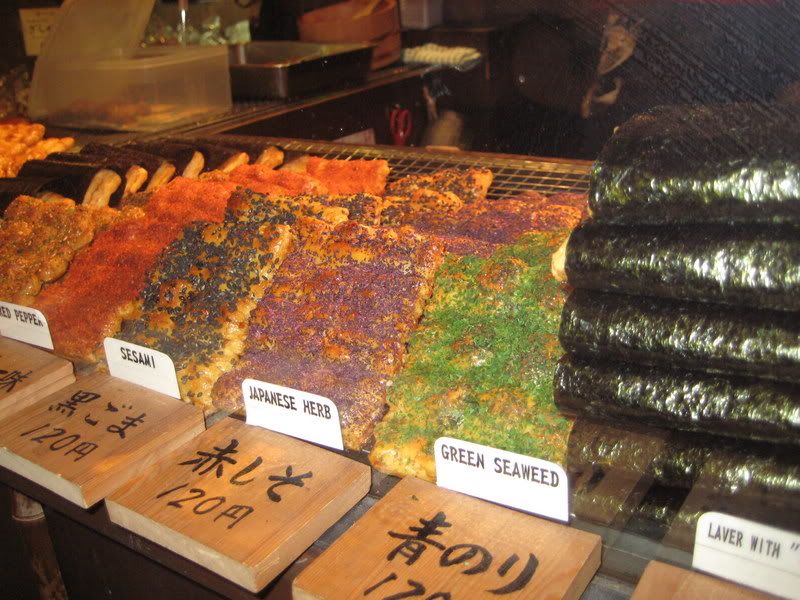
Jam packed with vendors hawking freshly pounded mochi, a rainbow of pickled vegetables, homemade rice crackers and skewered street food, Nishiki Market made my brain crackle with overstimulated food lover's anxiety. I wanna try that! Look at this! What are those? That smells good! We stopped at a little stand for grilled oysters with lemon and giggled with gluttonous glee. As we wandered through the over-300-year-old market, I nibbled a giant fish cake wrapped with bacon, and decided it was possibly the best thing I've tasted in Japan.

Cooking Class, Kyoto                                       

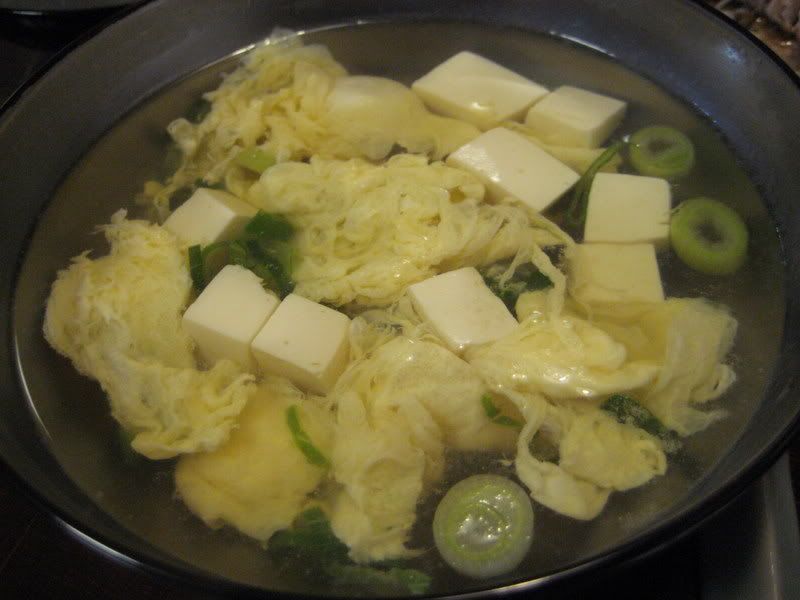
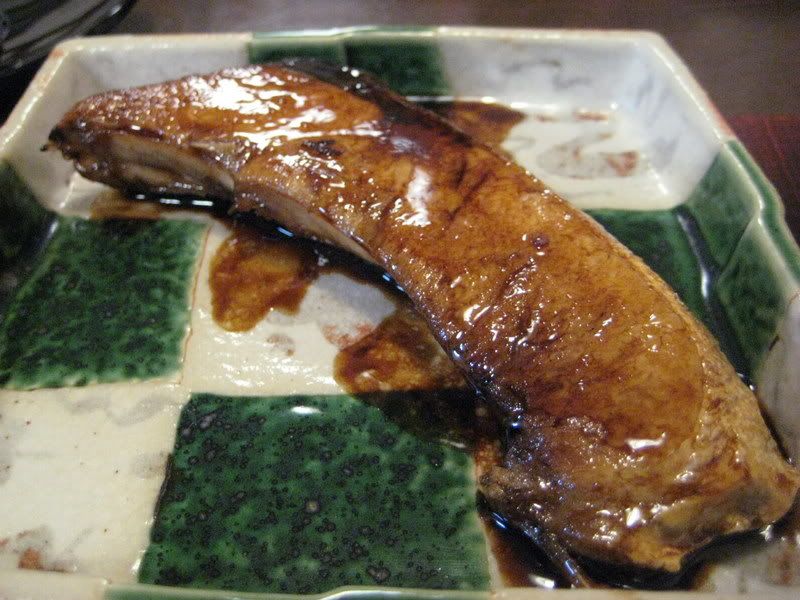
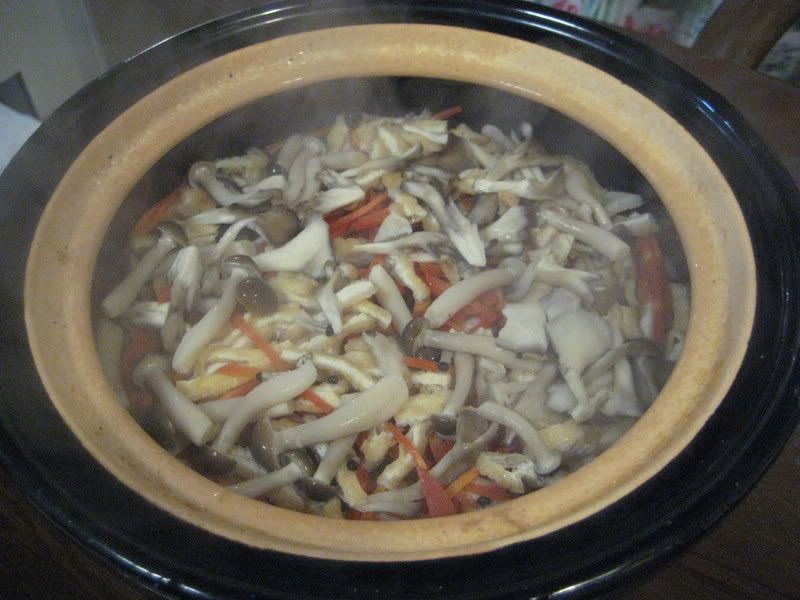
Thankfully, Cathy is perfectly happy spending the majority of our trip shoving delicious things into our mouths. We signed up for a cooking class and were extremely pleased to discover it would be held in our teacher's spacious home kitchen. There was only one other student, an adorable Chilean gal living in Brazil, and together we prepared homemade dashi for a soup, teriyaki fish, a super tasty rice, chicken and veggie dish, and a spinach & shitake salad with sesame dressing. Our soft spoken teacher, Mariko, was the perfect hybrid of a modern and traditional Japanese woman, and the class was a definite highlight of our trip. She served us tea and cool slices of slick persimmon for dessert. 


Karaoke

Remember that scene in Adventures in Babysitting when the big, scary, deadpan dude says "Nobody leaves this place without singing the blues?" Well, that's pretty much just like Japan, except instead of the blues it's karaoke. You gotta do karaoke in Japan. It's pretty much mandatory. To my shock and amazement, my gal Cathy admitted she was a karaoke virgin. So Christmas night, instead of sipping eggnog and baking Jesus shaped Christmas cookies, we sang our faces off. Wham! Snoop Dogg. Cher. Hank Williams. No cheesy 80's ballad was left unsung. This proved to be a warm-up for Kyoto, where we would link up with some superfun hostel dwellers for a late-night karaoke extravaganza. Those with stage fright needn't worry; in Japan you get your own karaoke private room, a remote control to pick your songs, a tambourine (!) and all-you-can-drink soda. No one notices the tall cans of Asahi you smuggle in with your purse.

Tokyo

Always up for something a bit bizarre and out of the ordinary, Cathy and I found ourselves booking "rooms" at a capsule hotel in the Shinjuku district of Tokyo. They only had "luxury capsules" left which meant we got a chair and a tiny desk in addition to our little cubby hole. So luxurious. It was actually quite nice, compared to a hostel dorm room, where you don't get a little privacy curtain.


In Tokyo we continued our habit of walking approximately 132,000 miles a day, until our legs ached and our feet threatened to pop off our ankles.

One morning we joined masses of other fish fans at Tsukiji Market, the world's largest wholesale fish market, where sumo-wrestler sized tuna are auctioned off in the wee hours of morning for hundreds of thousands of dollars each. We went for breakfast, but by 9:30am the queues at the most popular sushi counters were already two-hours deep. Fuck that noise. Instead we opted for fresh fish, sans the hype, and nibbled on perfectly delicious nigiri and hand rolls at a crowded counter manned by an old chef who looked like he could slice sashimi in his sleep. We also strolled Kappabashi, an entire neighborhood devoted to selling kitchen gadgets, cookware and the fake, but incredibly real looking, plastic food displays used by so many restaurants.


New Year's Eve, Tokyo

It turns out our Kyoto karaoke buddies were also spending New Year's in Tokyo, so we pieced together a 13 person posse and headed for Shibuya to ring in 2010. Normally I am turned off by traveling with such a big group of sorta-strangers: no one can agree where to go, people wander off, one girl gets too drunk and locks herself in the bathroom barfing. But no such shenanigans occurred and it turned into one of the best New Year celebrations I can remember. When the clock struck midnight, we were standing shoulder to shoulder in Shibuya Crossing, with masses of people from around the world, under the pulsing neon lights and massive plasma screens fixed to the sides of buildings.

As we weaved through the crowd, in search of a bar, we hugged strangers, shook their hands, called "Happy New Year" to everyone in our path, and really meant it. My cheeks ached from smiling. I felt connected to every single person on the street. I wasn't thinking about the future or the past or people I wished were with me or getting another beer. I was completely in the moment and so happy to be there.


Monday, January 4, 2010

In the kitchen: Japanese Cooking Classes!

Back in October, when I finally arrived at my apartment after a week of hotel living, I couldn't wait to get to the grocery store and start cooking my own meals. Foreign grocery stores are one of my favorite things in the world, and my first trip to Apita supermarket was a three hour affair. I wandered up and down each isle, squinted at the mysterious characters printed on packages and marveled at the huge selection of colorful, pickled vegetables in the refrigerator section. I was determined to cook only Japanese foods and filled my cart with miso paste, tofu and a two foot long bundle of skinny green onions.

Two weeks, and dozens of saran wrapped onigiri, later and I had completely exhausted my supply of Japanese recipes. I wanted to try new dishes but felt helpless, unable to read the labels on the bottles and jars in the grocery store. Was this mirin or cooking sake or vinegar? Defeated and frustrated, I turned to comfort food. I bought a package of spaghetti and the only Parmesan cheese I could find: a tiny, extremely overpriced, green can containing the dreaded Kraft Parmesan of my youth. I went home, locked the door, boiled up the pasta and ate the entire packet of noodles coated in butter and showered with processed fake cheese, salt, a shake of nutmeg and a drizzle of truffle oil that I'd smuggled into the country inside a pair of striped knee socks.

A few days later, I discovered that a foreigner-friendly community center near my apartment holds a free cooking class once a month. Unsuccessful in my attempts to find a cooking school, I couldn't believe my luck, and counted down the days until my first class.

The morning of class, I slid the paper screen door open and took off my shoes, adding my giant clown-like flats to the pile of teeny tiny boots and minuscule old lady loafers. Inside, a gaggle of hens in mismatched aprons were already peeling daikon and washing rice, clucking away and laughing in the large sunny kitchen. I was thrown an apron and handed a pile of shitakes to slice. The class was less of a formal class, and more of a let's-all-cook-together and eat lunch kind of affair. I watched the teacher as she poured mirin, soy sauce and sake, the holy trinity of Japanese cooking, into a hot pan of chopped greens before thrusting a pair of long wooden cooking chopsticks into my hands.

"You stir!" she commanded, a big watermelon slice of a smile on her shaggy bowl-cut framed face. 


The other teacher (far right in photo), who has since sent me an email declaring herself my "Japanese mother," proudly showed me photos of her baby grandson, but her face turned sour, and she clucked her tongue, before telling me about her other "bad son."

"He live in Tokyo and he has skin head! He in a band. Very loud. Not married. No good." A photo from her cell phone revealed a good looking guy with the cursed shaved head. She clucked again. "No good."

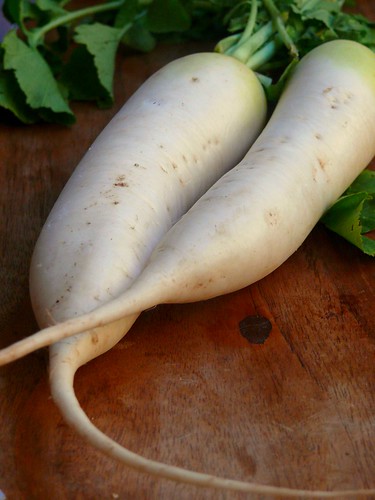
There wasn't a measuring cup in sight, so I took photos and tried hard to remember how to replicate the dishes we were preparing. Our little assembly line turned out savory foil packet salmon filets, smeared with miso, on a bed of caramelized onions and topped with shitakes, matchstick carrots and fresh parsley. We ate "good luck" rice, usually reserved for special occasions and served to girls after their first period, laced with red adzuki beans and sprinkled with coarse salt and black sesame seeds. I learned that the peels of a daikon should not be thrown away; they can be julienned and transformed into a side dish, along with the root vegetable's scraggly leaves, which are boiled, chopped fine and stir fried with the Holy Trinity and a small scoop of sugar. Lastly, we made a simple miso soup and tossed in all the extra veggies and plenty of chopped green onions.


The next class turned out to be a rare treat: we would be preparing a traditional New Year's Meal called Osechi. When I told my Japanese co-workers, they were surprised and impressed. Nowadays, most people order their osechi pre-made, giving the women a break from the everyday grind in the kitchen. Each item on the plate is symbolic of the New Year, and families across the country eat similar foods just like Americans on Thanksgiving. The meal is made up of many small components, varied in color and texture, and arranged artfully on the plate.

We started off  peeling: first the ginkgo nuts, collected from a nearby tree, were roasted until tender and threaded onto pine needles. Meanwhile, a couple of women peeled tiny boiled quail eggs, scored the tops, and carefully nestled a single salmon egg inside, like a jeweler setting a sparkling ruby into a ring. I was on fish cake duty, slicing the pink tinged loaves into half moons, and then making a few slits and transforming them into fancy fish cake twists.
There was a sort of stew packed with Japanese root vegetables, chicken, mushrooms and konjaku (one of my favorite Japanese food discoveries), teriyaki chicken and a shredded carrot and daikon salad. But my favorite part of the meal was the creamy black soy beans, sprinkled with Kanazawa's famous gold leaf.

At the end of the meal it was business time; I wanted to secure a deal with the two adorable teacher ladies. I wanted private cooking lessons. Once a month was not gonna cut it. They agreed, and no matter how much I tried, they insisted I only pay for the cost of the food.

This month: Project Eggplant!